① The campaign’s own number, starting a conversation② The page each link opens: no app, no account
Tue Sep 22 6:30 PM
Hi, it’s Mark Warner’s team. Here’s where Mark stands: Prepare workers for jobs lost to AI. In his words: “We could see 30% unemployment among recent graduates unless we get serious about preparing for AI’s changes to our economy.” Want to endorse Mark too? Reply STOP to opt out.
YES
You’ve endorsed Mark Warner. What name should we show? Only your first name and city appear publicly.
Tanya
Want to know if Mark is on your ballot? We’ll check. Send your home address, including your zip code. For example: 1000 E Broad St, Richmond, VA 23219.
4301 E Parham Rd, Henrico, VA 23228
Is this your address: 4301 E Parham Rd, Henrico, VA 23228? If not, send the right one.
Yes
Mark is on your ballot Nov 3, so your endorsement counts as a vote pledge. Share your link: amnd.it/VX3KP9
One more way to help: chip in to Mark’s campaign. Reply 10, 25 or 50, or any amount.
not now
Okay, nothing charged. Reply DONATE anytime.
Wed Sep 30 7:45 PM
Hi, it’s Mark Warner’s team. We’re pushing to close out the cycle strong. Reply 10, 25 or 50 to chip in, or any amount. Reply MONTHLY to give every month. Reply STOP to opt out.
Thu Oct 1 7:15 PM
Rosa pledged her vote for Mark from your link.
nice!! sent it to my book club too
Sat Oct 3 6:07 PM
31 days until the general election on November 3, 2026. Which do you want to see? Reply:
EARLY for early voting sites
DROP for ballot drop boxes
Election Day polling places aren’t posted yet, so check back closer to the election.
EARLY
Your nearest early voting site: Western Government Center, 4301 East Parham Road, Henrico, VA 23228. Next open Mon Oct 5, 8a-4:30p. Reply DIRECTIONS for directions, or MENU for your other options.
going Monday with my mom 🗳️
Your endorsement receipt
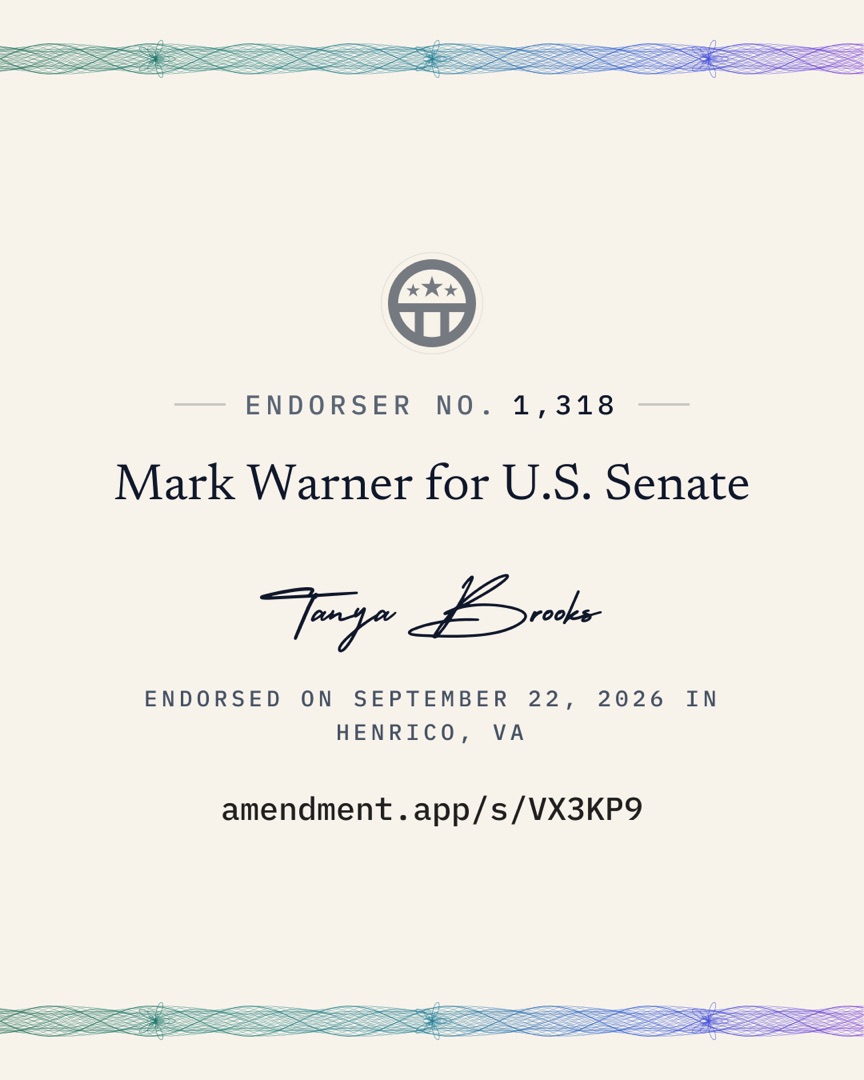
Share it. Anyone who pledges through your link counts to you.
Friends of Mark Warner
Chip in to Mark’s campaign
Employer · Occupation
Henrico Doctors’ Hospital · Nurse
Apple Pay or card, once, on Stripe’s secure checkout · Paid for by Friends of Mark Warner
✓ $50 to Friends of Mark Warner
Thank you, Tanya.
Your receipt is in your email. Processed by Stripe, straight to the campaign’s account.
Paid for by Friends of Mark Warner
A texting vendor
Amendment on your number
Who sends it
Your number
Your number. The sender doesn’t change
The first text
A donate link to the whole list
Where Mark stands, and one question. A YES starts the conversation: their name, their address and the pledge, all by text
What a reply starts
Nothing. The next blast is the same text to everyone
A conversation. Every text after gives them something to do, and you see who answers
What the link knows
Nothing. The same form for everyone
Who tapped it: their receipt, with their name, their endorser number and their own tagged link
What you learn
A click, maybe a gift
A placed Virginia voter, their pledge, their gifts, and everyone they bring in
The next text
Another blast to everyone
What they’ve earned or need: their link worked, the quarter’s closing, where to vote
How many on your list reply, open the link and act is what a pilot on your list measures.
Tap a link in the texts to move the page. The texts match the live demo word for word; where Mark stands is demo data, not his words. Tanya, her list and the page’s amounts are illustrative.